

By Connor Jorgensen, Director of Business Development, TUSK Practice Sales
Picture the day you hand over the keys. The day you walk out of your operatory for the final time as the owner. Now count backward. If that day is five years away, the decisions that shape your exit are the ones you are making right now.
If you are considering selling a dental practice in Kansas, Missouri, or Arkansas, starting early can help you protect its value and maintain control over your transition. Dentists who wait until they are ready to retire may discover that recent financial performance, staffing concerns, lease terms, or other issues have already limited their options.
When a dentist says they are about five years away from selling, they often mean they will start thinking about the transition in four years and sell in five. That timeline rarely works. By the time you go to market, the previous two or three years of financial statements are already shaping the offers you may receive.
A buyer also needs continuity of care and may not have a replacement ready to step in immediately. Whether you plan to sell a dental practice in Kansas, Missouri, or Arkansas, your five-year runway should include preparation, marketing, due diligence, closing, and any required post-sale transition period.
Your Personal Timeline Matters as Much as the Practice
Start with your own goals. When do you actually want to step back from the chair?
If you plan to reduce your production and create a better work-life balance, that change must be timed carefully. You should generally be prepared to continue practicing while the business is on the market and, depending on the buyer, for several years after the transaction closes.
Many DSO transactions include a three-to-five-year post-closing employment agreement. Buyers may also continue reviewing the practice’s financial results after you sign a letter of intent to verify that revenue, production, and profitability trends remain consistent.
Dentists sometimes reduce their schedules while actively speaking with buyers. This can weaken production and cause a buyer to lower its valuation or lose confidence in the opportunity. Traditional doctor-to-doctor transactions may require a much shorter transition period, but buyers will still want evidence that the practice can maintain patient relationships, staff stability, and financial performance after the sale.
An experienced advisor familiar with Kansas dental transitions can help you compare DSO offers with private-buyer opportunities and determine which structure best supports your financial and professional goals.
What Planning the Sale of Your Dental Practice Involves
Preparing for a clean dental practice transition takes time. Buyers will usually evaluate the practice using its trailing 12 months of performance while also reviewing longer-term trends.
That evaluation may include:
- Collections, revenue, and production trends
- Earnings before interest, taxes, depreciation, and amortization, commonly called EBITDA
- Owner expenses and documented add-backs
- Production by provider
- Hygiene production and capacity
- Service and payer mix
- Active patient counts and new-patient flow
- Associate and staff retention
- Facility condition and available operatories
- Real estate ownership or lease terms
- Competition and the local market
Regional factors also matter. A dental practice for sale in Kansas City may be evaluated differently from an opportunity in Wichita, Topeka, or a rural Kansas community. The same is true for practices in St. Louis, Springfield, Little Rock, Fayetteville, and other markets across Missouri and Arkansas.
A qualified Kansas dental practice brokerage advisor can assemble the marketing materials, normalize the financials, identify potential concerns, and present the practice’s strengths to prospective buyers. This process also gives the seller an opportunity to correct problems before they surface during due diligence.
Pre-market preparation commonly includes clean financial statements, documented add-backs, a defensible calculation of normalized EBITDA, production-by-provider reports, hygiene reports, staffing information, lease documentation, and other operational data. Preparing these materials can take four to six weeks.
The next stage is taking the practice to market. A structured process allows you to compare qualified buyers, evaluate transaction terms, and determine whether each candidate offers the right cultural and financial fit.
After selecting a buyer and signing a letter of intent, you enter due diligence. During this period, the buyer and its advisors verify the financial, clinical, operational, legal, and real estate information provided about the practice. Many DSO transactions take six to nine months from initial preparation through closing. This period usually does not count toward a post-closing employment commitment.
Preparing to Sell My Dental Practice in Kansas
If you have searched for information about how to “sell my dental practice in Kansas,” the most useful first step is not immediately listing the business. It is determining what the practice is worth today and what could improve its value before a sale.
Common preparation priorities include:
- Maintaining consistent collections and profitability
- Documenting legitimate owner add-backs
- Strengthening hygiene production and patient retention
- Addressing staffing gaps and associate agreements
- Reviewing the office lease and available renewal options
- Updating equipment strategically without overspending
- Correcting bookkeeping or compliance concerns
- Creating a realistic transition and retirement timeline
These same priorities apply to dentists preparing to sell in Missouri and Arkansas. However, buyer demand, local demographics, competition, provider availability, and financing conditions can differ considerably by community. Working with advisors who understand the regional market helps ensure that those differences are reflected in the valuation and marketing strategy.
Where You Actually Stand in Your Exit Timeline
Work backward from the date when you want to be completely finished practicing.
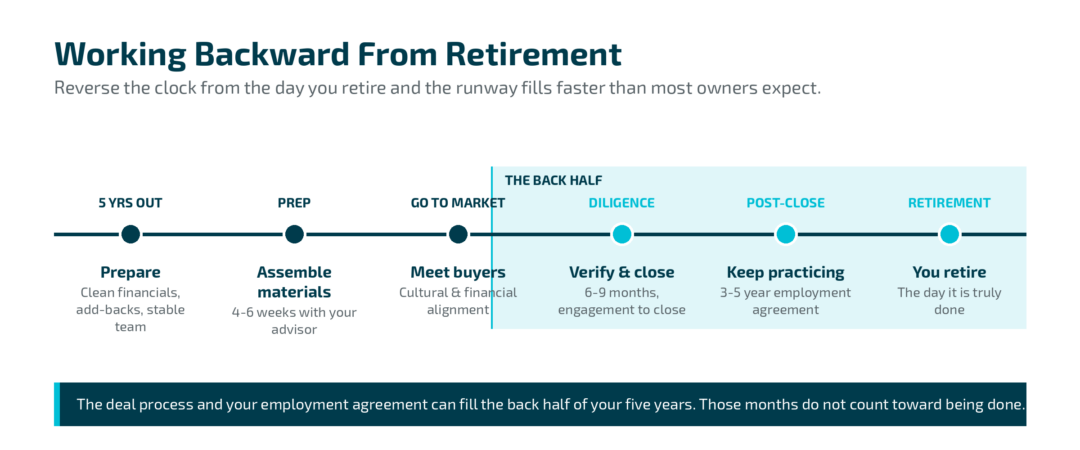
If you want to be fully retired within five years, you may need to begin evaluating your options now. The sale process and a typical post-closing transition period can consume much of that five-year window.
If retirement is six or more years away, now is an ideal time to prepare. Obtain a valuation, stabilize your team, review your lease, address structural weaknesses, and identify changes that could increase profitability while you still have time to act thoughtfully.
Dentists who leave money on the table are often those forced into a reactive sale. A health event, burnout, staffing problems, declining patient volume, increased local competition, or compressed margins can quickly change the seller’s negotiating position.
Planning in advance allows you to approach Kansas dental practice sales from a position of strength. It also provides time to evaluate whether you want to pursue a private doctor-to-doctor sale, a DSO transaction, an associate buy-in, or another transition structure.
Finding Dental Practices for Sale in Kansas, Missouri, and Arkansas
Preparation is equally important for buyers. Dentists searching for dental practices for sale in Kansas should evaluate more than the purchase price. Patient retention, provider dependence, staffing, lease terms, equipment needs, payer mix, and the seller’s transition plan can all affect the long-term success of an acquisition.
Searches for a dental office for sale in Kansas or a dental clinic for sale in Kansas may produce opportunities with very different operational profiles. Some dental offices for sale in Kansas are established, cash-flowing practices, while other dental clinics for sale in Kansas may require additional investment, recruitment, or operational improvements.
The same principles apply to dental practices for sale in Missouri and dental practices for sale in Arkansas. Buyers should compare the practice’s historical performance with its local growth potential and confirm that the opportunity supports their clinical, financial, and lifestyle goals.
Experienced Kansas dental practice brokers can help sellers reach qualified buyers while giving both parties a more organized path through valuation, financing, due diligence, negotiations, and closing.
Get Honest About Your Dental Practice Transition
If you take nothing else from this discussion, spend time considering these questions:
- When do I actually want to retire from dentistry?
- What do I need from a sale, both financially and operationally?
- How long am I willing to continue working after closing?
- Can I maintain or grow the practice on my own?
- Do I need additional support to keep performance moving in the right direction?
- Would I prefer a private buyer, DSO, associate, or another transition structure?
- Are my lease, team, financial records, and patient trends ready for buyer scrutiny?
You do not have to be ready to sell your dental practice to begin preparing. A dental practice valuation and an honest conversation about your timeline are among the lowest-pressure steps you can take. They can show you where the practice stands today and what you may need to change before entering the market.
Plan Your Dental Practice Sale in Kansas, Missouri, or Arkansas
Whether you are exploring Kansas dental practice brokers, preparing for a sale in Missouri, or considering an Arkansas dental transition, early planning gives you more control over the timing, value, and structure of the transaction.
DDSmatch can help you understand your current position, evaluate potential buyers, and create a transition strategy aligned with your personal and financial goals.
Schedule a confidential discovery call with DDSmatch to begin planning the sale of your dental practice in Kansas, Missouri, or Arkansas.